

The Wheat Field Test
Why Equality So Often Turns Against Excellence


By Will Ogilvie Vega de Seoane.
Some stories are old—really old. The theme is older still. Long before political theory hardened into law codes or proclamations, rulers were already asking the same anxious question: How do I stay in power? This is one of the earliest political stories preserved in narrative form. A ruler, uneasy on his throne, wants a method—something he can apply.
In the Western tradition, this book is often said to mark the beginning of history, and its author, Herodotus, is duly named its father. The title fits—so long as we remember that his history is playful, curious, and deeply human, closer to a good story than to a modern textbook. In The Histories, written roughly two and a half millennia ago, Herodotus tells us how Periander, tyrant of Corinth, dispatches an envoy with a clear task: travel to Thrasybulus, tyrant of Miletus, and return with practical advice on how tyranny is maintained. The messenger expects instructions. A principle. Perhaps even a short handbook of political survival.
He gets none.
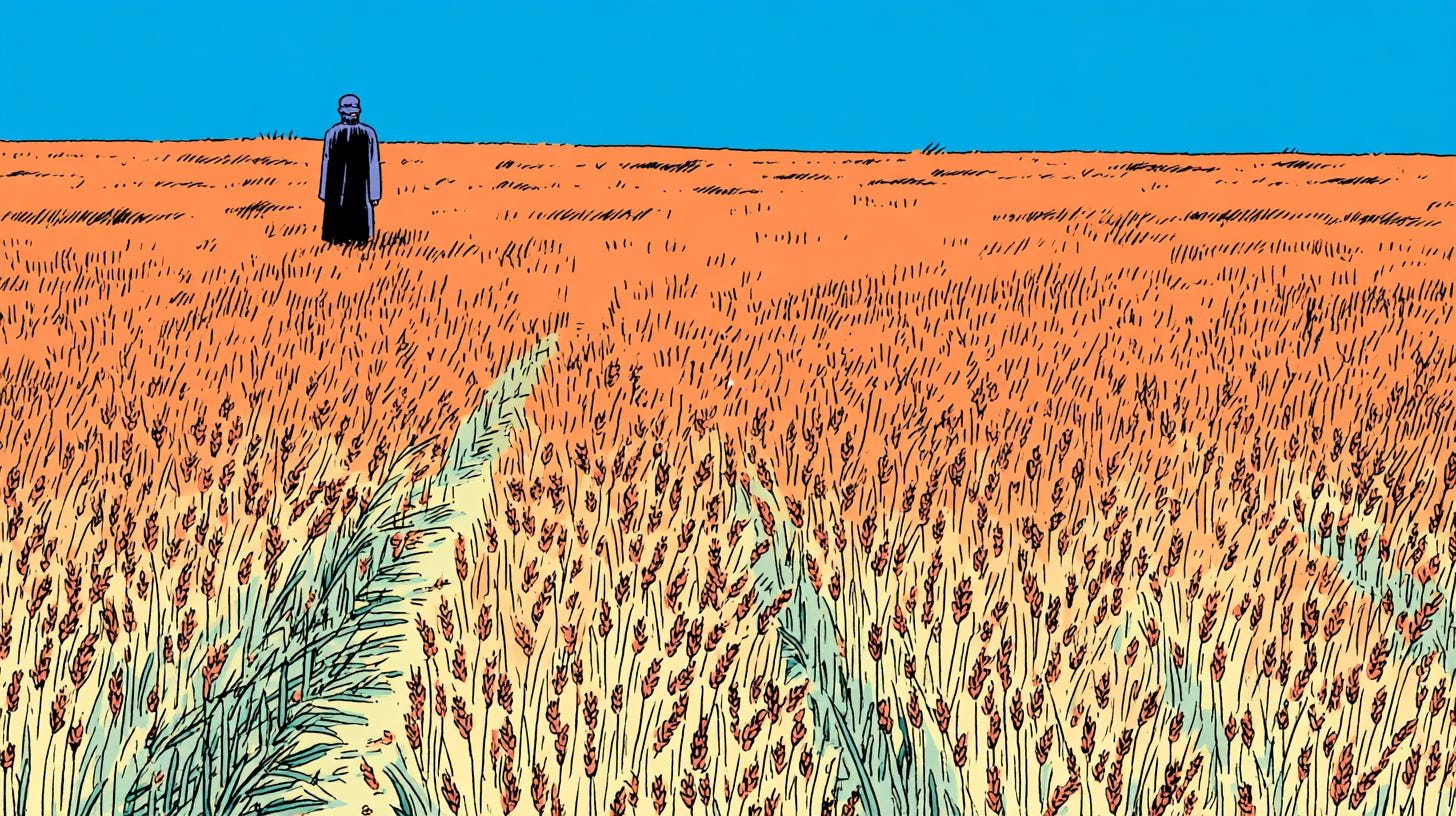
Thrasybulus leads him outside the city, into a field of wheat—golden, heavy, standing tall under the sun. As they walk, the envoy repeats his question again and again: How can Periander rule most securely? Thrasybulus listens in silence. Each time the question is asked, he calmly cuts down the stalks that rise above the rest. When the field has been neatly leveled, he dismisses the messenger without explanation. The envoy returns to Corinth shaken and confused, carrying not wisdom but a strange and useless story. One can imagine him rehearsing his report along the road, puzzled, aware—one suspects—that confusion is not a marketable skill in the court of a tyrant. He crossed miles to consult a master of politics and came back with… gardening tips. When he finally speaks before Periander, his account must sound apologetic: no words, no counsel, no doctrine—only a walk, a field, and a man who answered every question by cutting down the tallest stalks.
Herodotus delivers the punchline with perfect restraint: Periander understood immediately. No explanation was needed. The lesson was clear. To rule securely, one must remove those who rise above the rest. Power is not threatened by the mediocre or the obedient, but by the exceptional. Excellence attracts loyalty, admiration, comparison—and comparison is dangerous. The messenger’s failure to understand is the hinge of the story. He sees wheat being cut and suspects madness, because he is a servant and expects words. The tyrant sees wheat being cut and recognizes a governing principle. Keep them poor. Keep them mediocre. Keep them low.
What gives this episode its enduring force is that it does not remain safely confined to tyranny. Several generations later, Aristotle returns to the wheat field—not as a historian, but as a political theorist confronting an uncomfortable problem. What, he asks in the Politics, should a city do when a citizen arises who is so outstanding in virtue, talent, or influence that treating him as merely one equal among others seems unjust?
Some men, Aristotle says, are “like gods among men.” To force such figures into strict equality is not fairness but distortion. Equality, when applied mechanically, can become a kind of violence against reality.
Aristotle sharpens the point with almost comic cruelty. He recalls a fable in which the hares declare all animals equal, to which the lions reply that they will gladly agree once the hares acquire claws. Equality by decree does not erase real differences; it merely resents them. He then reminds us that the Argonauts abandoned Hercules not because he was wicked or incompetent, but because he was too strong. He weighed more than all the others combined and slowed the ship. Excellence, in other words, is often inconvenient.
And here is the unsettling turn: this logic does not belong only to tyrants. Democracies practice it, too. Athens famously institutionalized it under the name of ostracism, exiling citizens not for crimes, but for prominence—for being too admired, too influential, too exceptional. It was the wheat-field logic, translated into law.
And yet Aristotle refuses to stop there. Ostracism, he argues, was not conceived merely to indulge envy or to protect mediocrity, but—at least in principle—as a safeguard against tyranny. In certain circumstances, a democracy may act prudently when it restrains a politically ambitious individual whose power or charisma threatens to overwhelm the constitutional order. There is, to be fair, a case for leveling political ambition. In practice, however, ostracism often served as little more than a factional weapon.
But be careful here, dear reader, because this is where the ground begins to tilt. Once that logic slips from the public realm into private life—once excellence itself becomes suspect, once ambition as such is treated as a danger—the city is no longer defending its freedom. It is quietly, methodically teaching its citizens not to rise.
If this were only an ancient anxiety, it could be dismissed as nostalgic pessimism. But the pattern reappears, with unsettling familiarity, in modern democracies. Alexis de Tocqueville warned that the passion for equality was stronger than the passion for freedom. Equality flattens social distinctions, weakens informal authority, and leaves citizens increasingly dependent on a vast, bureaucratic administration. The result is not terror, but what he called soft despotism: a system that discourages independence, distinction, and greatness of soul while assuring everyone that this is for their own good. No wheat fields are needed. The cutting is done through regulation, taxation, cultural suspicion, and moral pressure.
Once you see this, it becomes hard to unsee. Contemporary societies often penalize success while praising fairness, treat exceptional achievement as provocation, and quietly reward conformity. Ambitious students learn to downplay excellence. High performers relocate without ceremony. Public discourse grows wary of anything that rises too far above the mean. None of this requires conspiracy. Like Thrasybulus, societies rarely explain themselves. They simply keep cutting.
As for me, the most revealing figure in Herodotus’s story is not the tyrant, but the messenger. He does exactly what he is asked to do. He observes carefully, reports honestly, and acts in complete good faith. If he fails, it is not through malice or stupidity, but through innocence. He expects power to explain itself plainly. When it does not, he assumes that there is nothing to understand.
Periander, by contrast, needs no explanation. He understands the gesture immediately because he already shares the unspoken logic behind it. The difference is not moral worth, but disposition: one takes the world at face value; the other looks for what is being selected, removed, and eliminated. That gap—between honest literalism and tacit understanding—helps explain why the exercise of power is so morally perilous. It may also hint at why one of the hardest demands in the Bible is to be innocent as doves and shrewd as serpents: to see clearly without becoming cruel, and to understand the logic of power without letting it hollow out the soul.
A free society is not one in which nothing is allowed to rise above the rest. It is one confident enough to let excellence grow. Tyrannies fear great individuals. Free societies cultivate them. The challenge is everlasting: whether we reach instinctively for the sickle—or whether we dare to follow the most unfashionable and audacious advice ever given to power: laissez faire.

Will Ogilvie Vega de Seoane teaches political philosophy and international politics at Hesperides University, where he also directs the Bachelor’s Degree in PPE and the Conversations on the Great Books. He holds a PhD in philosophy from Universidad Francisco Marroquín.
"And the trees are all kept equal/By hatchet, ax, and saw!"
https://www.youtube.com/watch?v=8_D0wkLyCXE