

The Prophet, de Tocqueville
The Potentialities and Dangerous Implications of Democracy in America

This article by William Henry Chamberlin (1897–1969) was published in the December 1958 issue of The Freeman.

One of the surest tests of a great book is durability. A commentary on the life and institutions and national character of America in the time of Andrew Jackson that still remains fresh and vivid and lifelike marks the author as an observer and writer of rare talent. It is never an easy task to sift the wheat from the chaff, the important from the trivial, the permanent from the transient in a manner calculated to satisfy the judgment of posterity.
But when a foreign observer in the United States a century and a quarter ago not only presents a singularly discerning analysis of the early American Republic, with its virtues and faults, its strength and weakness, but also writes with almost uncanny prescience of many social and political developments that became clear only in the twentieth century, long after he was dead, he deserves to be regarded as something more than a gifted observer. He deserves the title of prophet, and his book is one of the absolutely indispensable classics in the field of political science.
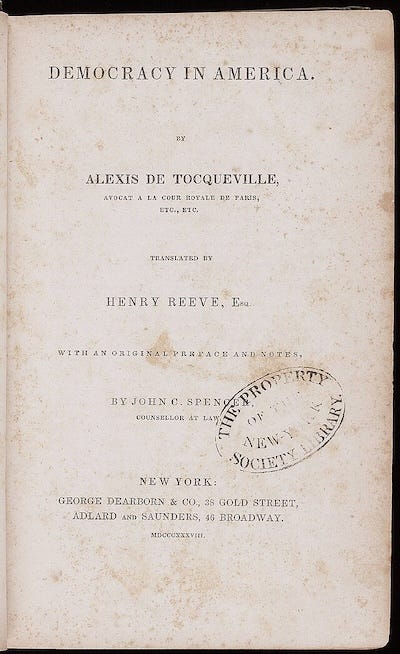
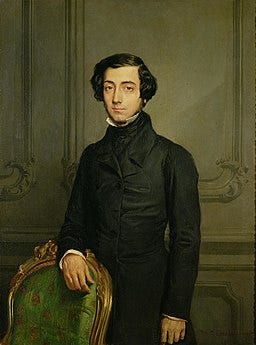
The man in question is Alexis de Tocqueville; the book is Democracy in America, de Tocqueville’s record of the impressions which he gained from a tour of America in the early eighteen thirties. His primary concern in America was to study the working of what was then considered to be a new and revolutionary conception of government “of the people, by the people, for the people,” without a monarchy, an hereditary aristocracy, an established church. De Tocqueville approached this study with admirable open-mindedness and freedom from doctrinaire prejudice. As a young man he forecast his own career in these words:
I do not know any way of life more honorable or more attractive than to write with such honesty about the great truths that one’s name becomes known to the civilized world.
He lived up so well to this ideal in his writing that his Democracy in America, along with his other works, The Old Regime and the French Revolution and his observations in England and Ireland, remain as an impressive monument to his memory. He was entirely without the superciliousness of some European visitors who could see nothing in America but rough frontier manners, such as the common habit of spitting tobacco juice in all directions.
Self-Government Commended
De Tocqueville was discerning and generous in recognizing the positive benefits that flowed from the scheme of government devised by the Founding Fathers: the respect for law because of the prevalence of self-government, the absence of arrogant display by officialdom, the immensely productive energy that comes from individual self-reliance, the absence of the burdens of militarism. This mirror of the past America may be in some respects an unconscious criticism of the America of 1958, with its vast bureaucracy, heavy taxation, increasing arrogation of power by the federal authority, and growing remoteness of the governing process from the people.
“The European,” writes this French observer, “generally submits to a public officer because he represents a superior force, but to an American he represents a right. In America it may be said that no one renders obedience to man, but to justice and law.”
Reliance on one’s individual exertion, a reproach in the eyes of many who look on themselves as advanced social thinkers in our time, is the object of de Tocqueville’s repeated praise:
The citizen of the United States is taught from his earliest infancy to rely upon his own exertions in order to resist the evils and the difficulties of life; he looks upon social authority with an eye of mistrust and anxiety, and he only claims its assistance when he is quite unable to shift without it… When a private individual meditates an undertaking, however directly connected it may be with the welfare of society, he never thinks of soliciting the cooperation of the government, but he publishes his plan, offers to execute it himself, courts the assistance of other individuals, and struggles manfully against all obstacles. Undoubtedly he is often less successful than the State might have been in his position; but in the end the sum of these private undertakings far exceeds all that the government could have done. [italics supplied]
De Tocqueville notes that America had come much closer than Europe in giving its people a sense of conservatism in the most effective way: by creating conditions where they had something to conserve. So he tells of meeting a fellow Frenchman, who had been “a great leveler and an ardent demagogue forty years ago,” who had then emigrated to the United States and prospered as a planter. De Tocqueville, in view of his host’s background was somewhat surprised to hear him “discuss the rights of property as an economist or landowner might have done; he spoke of the necessary gradations which fortune establishes among men.”
This countryman of de Tocqueville is certainly not the only European radical whose views were changed by the influence of individual opportunity in the United States. De Tocqueville draws this interesting general conclusion:
In America those complaints against property in general which are so frequent in Europe are never heard, because in America there are no paupers; and as everyone has property of his own to defend, everyone recognizes the principle upon which he holds it.
De Tocqueville was quick to recognize the advantages which accrued to America from its isolated geographical position and from its adherence to Washington’s wise injunction to shun participation in the quarrels of Europe. In one of his most prescient passages he writes:
The Americans have no neighbors, and consequently they have no great wars, or financial crises, or inroads, or conquest to dread; they require neither great taxes, nor great armies, nor great generals; and they have nothing to fear from a scourge which is more formidable to republics than all these evils combined, namely military glory… The Union is as happy and free as a small people, and as glorious and strong as a great nation.
Three Serious Defects
Democracy in America is not an unqualified eulogy. He notes three serious defects: conformity, mediocrity, materialism:
It seems, at first sight, as if all the minds of the Americans were formed upon one model, so accurately do they correspond in their manner of judging.
In few civilized nations of our time have great artists, fine poets, or celebrated writers been more rare than in the United States… If the observer only singles out the learned, he will be astonished to find how rare they are; but if he counts the ignorant, the American people will appear to be the most enlightened community in the world. The whole population is situated between these two extremes… The spirit of gain is always on the stretch, and the human mind, constantly diverted from the pleasures of imagination and the labors of the intellect, is there swayed by no impulse but the pursuit of wealth.
And one of the unmistakable purple passages of the book gives this picture of the American who is never content with what he has, who is constantly on the move for new opportunities:
In the United States a man builds a house to spend his later years in it, and he sells it before the roof is on. He plants a garden, and lets it just as the trees begin to bear. He brings a field into tillage and leaves other men to gather the crops. He embraces a profession and gives it up. He settles in a place, which he soon leaves, to carry his changeable longings elsewhere… Death at last overtakes him, but it is before he is weary of his bootless chase of that complete felicity which is always on the wing.
De Tocqueville finds a democracy likely to be incompetent in the conduct of foreign affairs; perhaps many present-day Americans would agree with him. His observation on this point is as follows:
Foreign politics demand scarcely any of those qualities which a democracy possesses; and they require, on the contrary, the perfect use of almost all those faculties in which it is deficient… A democracy is unable to regulate the details of an important undertaking, to persevere in a design, and to work out its execution in the presence of serious obstacles. It cannot combine its measures with secrecy, and it will not await their consequences with patience.
The Past Mirrors the Present
In almost all his observations on the American past de Tocqueville shows himself a shrewd, perceptive observer and his impressions furnish a mirror in which Americans today may view their country and themselves. One fears that in the matter of individual self-reliance and distrust of government aid there has been a considerable falling off. And the former safety of geographical isolation has been seriously undermined by unwise policies and also by the impersonal march of science, which has automatically reduced very much the security which America enjoyed when it could only be approached by a boat, when airplanes and ballistic missiles were scarcely dreamed of.
But the French political scientist displays remarkable capacity not only to observe the present, but to divine the future. He visited an America that had no national debt, to speak of, no military establishment of any consequence, no welfare-state institutions, and no income tax. But he foresaw the danger that under democracy there might be a trend for the relatively poor majority to employ universal suffrage as a means of siphoning into their own pockets more and more of the income and property of the well-to-do minority. He forecast this probability almost as clearly as if he had before him a 1958 income-tax blank:
Wherever the poor direct public affairs and dispose of the natural resources, it appears certain that, as they profit by the expenditure of the State, they are apt to augment that expenditure.
I conclude, therefore, that the democratic government of the Americans is not a cheap government, as is sometimes asserted; and I have no hesitation in predicting that, if the people of the United States is ever involved in serious difficulties, its taxation will speedily be increased to the rate of that which prevails in the great part of the aristocracies and monarchies of Europe.
US and USSR
The most remarkable demonstration of the author’s prophetic gift is in regard to the twentieth century predominance, in world affairs, of the United States and Russia. At the time when Democracy in America was written, Russia was only one of several European great powers and the United States counted for very little in European power calculations. Yet de Tocqueville confidently offered this preview of a situation that actually came to pass more than a century later:
There are at the present time two great nations in the world which seem to tend toward the same end, although they started from different points. I allude to the Russians and the Americans… All other nations seem to have nearly reached their natural limits; but these are still in the act of growth. All the others are stopped, or continue to advance with extreme difficulty; these are proceeding with ease and celerity along a path to which the human eye can assign no term…
The Anglo-American relies upon personal interest to accomplish his ends, and gives free scope to the unguided exertions and common sense of the citizens. The Russian centers all the authority of society in a single arm. The principal instrument of the former is freedom; of the latter, servitude. Their starting points are different and their courses are not the same; yet each of them seems to be marked out by the will of Heaven to sway the destinies of half the globe.
Democratic Weakness
Despite his own aristocratic origin, de Tocqueville was clearsighted enough to recognize that the Old Regime in France, and in Europe, was finished. He was also prescient enough to anticipate that democracy, without checks and balances, could degenerate into an absolutism more appalling than the old-fashioned monarchy. One finds in his work remarkable premonitions of communism and of fascism, of ruthless tyranny exercised in the name of a cowed, drugged, propagandized majority. Some of his writing on this subject has a very real and eloquent message for our time; de Tocqueville, who defies precise classification as a conservative or a liberal, can more accurately be described as a libertarian individualist:
Unlimited power is in itself a bad and dangerous thing; human beings are not competent to exercise it with discretion, and God alone can be omnipotent, because his wisdom and justice are always equal to his power. But no power upon earth is so worthy of honor for itself, or of reverential obedience to the rights which it represents, that I would consent to admit its uncontrolled and all-predominant authority.
In my opinion the main evil of the present democratic institutions of the United States does not arise, as is often asserted in Europe, from their weakness, but from their overpowering strength; and I am not so much alarmed at the excessive liberty which reigns in that country as at the very inadequate securities which exist against tyranny.
He then asks to whom an individual, if wronged in the United States, can apply for redress, when public opinion, the legislature, the executive are all subject to the will of the majority, and even the judges in some states are elected by the majority. What he is seeking is some means of forestalling or at least mitigating the possible tyranny of the majority.
Totalitarianism Foreseen
There is a vision of fascism and communism, with their massacres and proscriptions, in his only too well justified prediction that, should absolute power be re-established in Europe, “it would assume a new form and appear under features unknown to our forefathers.” Formerly, religion, sense of honor, family pride, provincial prejudices, custom, and public opinion limited the power of kings and placed a restraint on their authority. Now these restraining influences are weakened or destroyed and he fears a return to “those hideous eras of Roman oppression when the manners of the people were corrupted, their traditions obliterated, their habits destroyed, their opinions shaken, and freedom, expelled from the laws, could find no refuge in the land.”
In other words, the unlimited tyranny of a Stalin or a Hitler.
The Bureaucratic Burden
Perhaps the finest performance of de Tocqueville as prophet is this superb vision of the ultimate logical result of the Welfare State:
Above this race of men stands an immense and tutelary power, which takes upon itself alone to secure their gratifications and to watch over their fate. That power is absolute, minute, regular, provident, and mild. It would be like the authority of a parent if, like that authority, its object was to prepare men for manhood. But it seeks, on the contrary, to keep them in perpetual childhood. It is well content that the people should rejoice, provided they think of nothing but rejoicing. For their happiness such a government willingly labors. But it chooses to be the sole agent and only arbiter of that happiness. It provides for their security, foresees and supplies their necessities, manages their principal concerns, directs their industry, regulates the descent of property, and subdivides their inheritances—what remains, but to spare them all the care of thinking and all the trouble of living…?
The will of men is not shattered, but softened, bent, and guided. Men are seldom forced by it to act, but they are constantly restrained from acting. Such a power does not destroy, but it prevents existence. It does not tyrannize, but it compresses, enervates, extinguishes, and stupefies a people, until each nation is reduced to be nothing better than a flock of timid and industrious animals, of which the government is the shepherd. [italics supplied]
Here is Alexis de Tocqueville at his best, the searching and brilliant observer of his own century and the inspired prophet of many of the problems, perils, and pitfalls of the still unborn twentieth century.
Mr. Chamberlin was the author of numerous books, a lecturer, and a contributor to the Wall Street Journal and many nationally known magazines.