

Spain Is Awake
Madrid’s Economic Balancing Act

During summer months in Spain, there’s rarely any point in looking at a weather forecast. The prognosis is always sunny, with the only variable being just how hot it’s going to be. The same has been true of its economy over the last few years, which has consistently outpaced those of other EU nations—often by a big margin—and was named as the best in the world in 2024 by The Economist magazine.
Spain began a gradual process of growth and modernization in the early 1950s, as Francisco Franco approached the halfway point of his four-decade rule. Last year, the country celebrated a half-century of democracy since Franco’s death in 1975; and this year, along with its Iberian neighbor Portugal, looks back over four decades of EU membership. Spain’s Socialist prime minister Pedro Sánchez, a self-confessed “militant pro-European,” has described this period as “the best… in [Spain’s] history… We have built a first-class welfare state. And we have become a tolerant, diverse, vibrant, and attractive country for the whole world.”
Although the oil crisis triggered by the Iran War is expected to slow Spain’s growth slightly, Brussels’s latest projections indicate that it will remain a leader in Europe. In May, it was the only European country to have its growth forecasts increased since last fall, from 1.4% to 2.4% for this year and from 1.5% to 1.9% for 2027. Both are comfortably above the 0.9% and 1.2% projections for the Eurozone as a whole (the 21 countries that use the euro), as well as those for France and Germany, traditionally the bloc’s strongest economies. All of which is pretty impressive for a country that only emerged from a dictatorship 50 years ago, and whose economy has since been ravaged by a European debt crisis, a global recession, and a pandemic (during which Spain was placed under one of the world’s strictest lockdowns). How has Spain arrived at this point? And are there any factors lurking behind the stellar GDP statistics that might hold problems for the future?
In 1939, Franco’s Nationalist forces, supported by Hitler and Mussolini, won a three-year Civil War against the leftist Republicans. Although Spain was officially neutral during World War II, its ideological affinities with the Axis powers meant that it was excluded from the Marshall Plan. Isolated from the international community, its economy stagnated throughout the 1940s. Franco adhered to the autarky typical of authoritarian regimes, once claiming: “We have everything we need to live, and our production is sufficiently abundant to assure our survival. We do not need to import anything.” Things slowly started to change in 1953, when Franco signed the Pacts of Madrid with US President Dwight D. Eisenhower. In exchange for allowing the US to build 5 military bases in Spain for potential use in the nascent war against Communism, Eisenhower gave $1.5 billion in aid to Franco throughout the rest of the decade.
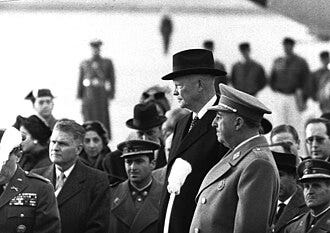
By the late 1950s, Franco seemed to have realized that autarky meant a slow death for the Spanish economy. Under the guidance of a newly-appointed group of technocrats, Spain joined the IMF and World Bank in 1958 and the Organisation for European Economic Cooperation (which became the OECD in 1961) the following year. With the Stabilization Plan of 1959, Madrid embarked on a period of expansion that would become known as the “Spanish Miracle” (1959–74). Fueled by $7.6 billion in foreign aid, over 40% of which came from the US, Spain became the second-fastest-growing country in the world after Japan.
The Spanish automobile industry expanded by 22% per year, aided by massive investment in state-owned companies such as car-maker SEAT. Over in the US, General Motors (GM) was pioneering a similar revolution. Charlie Wilson, president of GM throughout World War II and Eisenhower’s defense secretary from 1953, famously said that “what was good for the country was good for GM as well.” This was also true of Spain and SEAT, whose compact, affordable 600 model came to symbolize these “miracle” years of growth. The number of privately owned cars in Spain went from 72,000 in 1946 to over 1 million in 1966.
It wasn’t just Spaniards who were now able to travel around the country for holidays. In the 1960s, led by Franco’s Tourism Minister Manuel Fraga (who helped establish the country’s main center-right party, the PP, in 1989), Spain launched its tourism industry, with a campaign mainly aimed at European holidaymakers. Fraga personally went to extraordinary lengths to keep the visitors coming. On January 17, 1966, at the height of the Cold War, a US B-52 plane collided with a refueling tanker mid-air, accidentally dropping four hydrogen bombs near Palomares, on the southeastern coast. Two square kilometers were contaminated with plutonium, but in a risky publicity stunt, Fraga and US Ambassador Angier Biddle Duke took a dip in the sea. Their swim was broadcast all over Spain and even reached the front page of the New York Times: and the publicity worked. By the end of the 1960s, Spain was pulling in over 20 million visitors per year, and tourism accounted for 9% of GDP. Neither Fraga nor Duke suffered health problems as a result of their swim, nor were any of the local population affected—although radioactive snails were still being discovered in the area 40 years later.
Another key player in the Spanish tourism revolution was Pedro Zaragoza Orts, mayor of Benidorm from 1950 to 1967. In the 1950s, Benidorm was a quiet fishing village on the east coast, with just a few pensiones for out-of-towners. The word tourism didn’t even exist; instead, people spoke of veraneo, or “summering,” which typically involved well-off families from central Spain escaping to quiet coastal spots during the intense heat of July and August. But in 1959, Orts signed a municipal order allowing the wearing of bikinis—symbols of immorality, as far as the Catholic Church was concerned—on the town’s beaches. The local archbishop started an excommunication process against him, prompting Orts to drive his Vespa to Madrid in pursuit of Franco’s backing. He got it, the church order was dropped, and the bikini became a staple of Benidorm’s beaches. According to Giles Tremlett, a veteran Madrid correspondent for The Guardian and Economist, and author of Ghosts of Spain: “Without the bikini there, quite possibly, would have been no modern Benidorm and, in fact, precious little tourism at all.”
Today, Benidorm welcomes over 3 million visitors per year (some of them, perhaps, descendants of the sun-addled Brits captured in Martin Parr’s brilliant photographs from the 1990s). The apartment towers that have been built to accommodate them have given Benidorm the highest ratio of skyscrapers to citizens of anywhere in the world—one for every 2,970 residents.
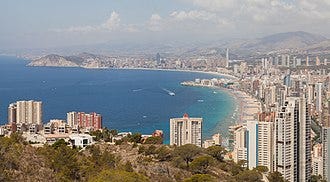
Benidorm can be seen as a microcosm of what has happened to Spain as a whole. Tourism is the engine that keeps the country running, regardless of what the politicians are up to (or not). The world’s second-most-visited country after France, it keeps breaking its own records, and last year welcomed 97 million visitors, up 3.2% from 2024. Tourism now accounts for 13% of Spain’s GDP and jobs. Its popularity has apparently been unaffected by recent protests against over-tourism in hotspots such as the Balearic Islands, Málaga, and Barcelona. These have, however, pushed several regional governments into (possibly misguided) attempts to control visitor numbers. Barcelona has taken the most draconian measures, and vowed to abolish all tourist flats by 2028. One wonders whether the city’s leftist mayor Jaume Collboni would quietly welcome a repeat of 1966’s plutonium accident; if there were, it’s unlikely that he’d jump in the sea.
Spain has also benefited substantially from EU membership. The “miracle” period of growth symbolized by the SEAT 600 was abruptly halted by global oil crises in 1973 and 1979. By the early 1980s, Spain’s economy had slumped again, with GDP growth around 1% per year and unemployment at 15%. The transition to democracy after Franco’s death in 1975—premised on a bipartisan “Pact of Forgetting,” which prohibited legal reprisals against both Francoists and Republicans—had also slowed expansion. Madrid saw membership of what was then called the European Economic Community as the best way forward. It seems to have been vindicated.
Since its accession on January 1, 1986, Spain has received over €150 billion in EU funding, which has contributed to GDP expansion of more than 100%. International trade has also benefited from membership of the European customs union: In 2024, global exports of Spanish goods were worth €141.5 billion (8.9% of GDP), compared to €12.6 billion (4.9%) when it joined. More recently, Spain was the second-biggest beneficiary of the EU’s Next Generation funding scheme, designed to help member states recover from the pandemic (and from governments’ attempt to contain it). Madrid received a total allocation of €160 billion, of which it has so far received around €60 billion; yet corruption and bureaucracy have severely hampered the deployment of these funds.
This 40-year trajectory has transformed Spain from an economic backwater to Europe’s star performer. But with a general election looming in 2027, persistent societal problems are once more provoking popular anger. Hidden behind the impressive macroeconomic data are structural imbalances that eight years of Socialist rule have not done much to alleviate.
Spain is currently in the grip of a severe housing crisis. Rental prices have soared by 80% over the last decade, and the Bank of Spain puts the deficit of new homes at 700,000. One reaction to this has been a widespread Okupas (squatters) movement, which even received the backing of Barcelona’s former leftist mayor, Ada Colau. A change in the law last year allows owners to cut off water and electricity in occupied houses without fear of prosecution, and permits fast-tracked evictions; but unless okupas are removed within 15 days, they can remain in Spanish properties for years, due to legal and bureaucratic complexities. Residents of tourist hubs also claim that they are being priced out of property markets by foreigners. The most recent protest against Spain’s housing crisis, attended by 100,000 people in Madrid on May 24, suggests that it will be a key issue in next year’s campaigns. So far, Sánchez has blamed foreigners and promised more public housing, rather than cutting red tape and incentivizing the private sector.
Despite Sánchez’s attempts to expand the welfare state, Spain remains one of the most unequal countries in the EU. Around 26% of the population lives at risk of poverty or social exclusion, putting it fifth in the EU rankings. Spain also has one of the worst child poverty rates in Europe, with 1 in 3 children living at risk of poverty or social exclusion. That this is a cyclical problem was highlighted by a 2024 report by the European Anti-Poverty Network, which found that 1 in 4 people who grew up in poor households in Spain were living in poverty in 2023–24%, as compared to a poverty rate of 20% for the rest of the population.
Unemployment—especially the long-term variety—is another scourge of Spanish society. Although it dipped to its lowest level in 18 years in the last quarter of 2025, it rose to 10.8% at the start of this year—almost double the bloc’s average of 6%. Sánchez’s government deserves credit for reducing temporary contracts from 30% to around 13% of the total; but these still proliferate in the hospitality and agriculture industries, alongside exploitation. Tourism might have transformed Spain’s GDP, but many of the jobs it provides are highly unstable—as reflected by the annual dip in unemployment during the summer and festive periods.
Nor has EU membership progressed without bumps in the road. The Eurozone debt crisis of 2008, combined with a burst domestic housing bubble, crushed Spain’s economy, causing it to contract by 3.6% in 2009. Austerity conditions imposed by the EU for a €100 billion bailout led to mass hardship and 27% unemployment. Out of this turbulent period grew an anti-establishment movement known as 15M, named after the huge protest camps staged in Madrid’s Puerta del Sol on May 15, 2011. Spain’s GDP has since recovered, and austerity has been reversed under Sanchez; but most of the issues that fueled the rise of the Indignados (The Outraged, as the 15M movement was also called) are as present now as they were 15 years ago, chief among them unaffordable rents, youth unemployment (the third highest in the EU at 24%), and corruption. The latter is so embedded in Spain’s political class that in 2025, Sánchez, whose minority government is now also engulfed in fraud scandals, made the extraordinary statement that “there is no such thing as zero corruption.” Not in Spain, perhaps.
The 15M movement triggered what has arguably proved the most important political shift in Spain since the transition to democracy. It was the platform on which two new parties, leftist Podemos and centrist Ciudadanos, rose to prominence. In 2015’s election, these upstarts split the national vote four ways for the first time. Spaniards, so long accustomed to voting for either the Socialists or the Conservatives, were suddenly presented with two new parties, both promising an end to corruption and complacency within the old guard.
After this historic election, both Ciudadanos and Podemos entered into coalitions or partnerships at the national level, and the leftist party especially exerted real influence; but by 2019, they were on the decline, unable to maintain their initial momentum. The newest party on Spain’s fragmented political scene is Vox, which emerged that same year on a strong unionist platform (an illegal 2017 referendum on Catalan independence plunged Spain into a Constitutional crisis). Vox—the Spanish branch of an international “far right” that Sánchez claims is out to destroy democracy—is now the third force in Spanish politics. It governs with the PP in several regions, an arrangement that could be replicated at national level if the Conservatives win in 2027. Spain’s old two-party system seems to have disappeared forever.
In 2018, a plaque was unveiled on Madrid’s Puerta del Sol, where the biggest protests took place seven years earlier. “Dormiamos, Despertamos,” it reads—“We were asleep, we woke up.” This is apt not just as a description of post-15M Spain, but of a process that has been taking place since the 1950s. It is still going on: on May 23, the day before the housing protests in Madrid, an estimated 120,000 people marched to the prime minister’s official residence, demanding Sánchez’s resignation over the corruption scandals. The outrage of 15M, 15 years on, has not disappeared. Perhaps it still has the power to shape Spain’s future.

Mark Nayler is a freelance journalist and critic based in Málaga, Spain. He writes regularly for The Spectator and Times Literary Supplement and is working on a biography of the philosopher Bryan Magee, due to be published by Bloomsbury (London) in 2028.
Many thanks. I've been struggling to understand Spain, through relative's comments, through my visits there over 46 years. For all the negatives, the country has seen an economic miracle, or three. In 1980, the RENFE train from Madrid to Granada frequently stopped, rarely surpassed 40MPH. I wondered at one point if I could get off and run faster to the next car up. Last year, we felt we were flying - first class - on the HSR to Valencia. 320kph. In 1980, I saw a burro pulling a plow.
One thing I admired about the relatives is what they called the fascist party - currently Vox: they call them "The fascists". As America struggled to say the word aloud. When "the fascists" are right there in your own family, (the have stiff relations on religious holidays, not otherwise), you know 'em when you see 'em...and they assure me that Vox members are just the children and grandchildren of Francoists. It's the same bunch, the Franco Party just has to change names about once a decade for the last two generations. They aren't speaking generally, but of colleagues, friends, relatives, they're speaking very specifically: Vox == Francoists.
Vox favour the rich getting richer, and not giving up an inch of land or any other real estate that they collect rents upon. They can get in, but will always be returned to opposition after they do a few of the things they like to do: cut programs and upper-income taxes.