



By Mark Nayler.
Summer is the season of glorious weather and holidays, of BBQs and trips to the beach—and now, it seems, of insatiable wildfires that consume areas the size of small countries. So far this year in Europe, fires have burned roughly 530,000 hectares (1.3 million acres), putting it on track to equal last year’s record of 1 million hectares (2.5 million acres)—a region slightly bigger than Cyprus. That figure rises to over 2.5 million hectares (6.2 million acres) in the US this summer and around 4 million hectares (9.9 million acres) in Canada. When smoke from the largest Canadian fires drifted into the US last month, Donald Trump helpfully told Canadian Prime Minister Mark Carney (in person, at the World Cup final in New Jersey) that he had to stop “poisoning our air.” Wildfires are also politically divisive in Europe—but there, a new strategy is urging countries to put their differences aside to combat these lethal fixtures of the summer season, which have so far cost the continent an estimated $19 billion in damages.
Most wildfires are not purely natural phenomena. Only a small proportion are caused by lightning, although such fires account for a higher ratio of land burned, as they usually occur in remote areas. According to the European Environment Agency, 95% of European wildfires are caused by humans, whether deliberately or by accident, while the US National Park Service puts that figure at nearly 90%.
The scientific consensus, however, is that global warming is making wildfires worse than they used to be. In an increasingly common cycle known as “weather whiplash,” wetter winters and springs create an abundance of greenery on forest floors, which rapidly dries out during summer heatwaves. The result is a huge amount of fuel for wildfires. Researchers at the University of Maryland estimate that forest fires now burn twice as much tree cover as they did in the early 2000s. The process is cyclical: according to EU statistics, this year’s fires have already released almost 18 million metric tons of CO2 into the atmosphere. Wildfires both feed off and contribute to global warming, in a destructive cycle that’s consuming more land every year.
The consistency and ferocity of wildfire seasons suggest that prevention needs to be prioritized, alongside the strengthening of countries’ capacity to fight blazes once they’re burning. It’s encouraging, then, that the EU Commission’s 2026 wildfire policy does exactly that, at least on paper. Anna-Kaisa Itkonen, the EU Commission’s spokesperson for energy, climate, environment, and transport, summed up the approach as follows: “We cannot focus only on literally putting out fires.” A price tag for this multinational strategy has not been announced, although the EU Commission has said that it wants 35% of the bloc’s next budget to fund climate and environmental policies. Brussels claims that effective prevention will ultimately save member states money, by reducing wildfire reparation costs that routinely run into the billions.
As well as augmenting its rescEU firefighting fleet with 12 new planes and 5 helicopters, the EU is focused on building “fire-resilient landscapes and [mitigating] the risk and impact of wildfires through nature protection and nature restoration.” It also aims to reinforce its European Forest Fire Information System, a satellite-based warning system that covers the continent, and to create a portal to share “funding routes and lessons learned with member states newly facing fire risk.” After this year’s wildfire season, several European countries will have even more hard-won lessons to share with the rest of the bloc.
In Spain, 223,000 hectares (551,000 acres) have burned so far this summer, 135% above the 20-year average. The fire that torched almost 55,000 hectares (136,000 acres) in the provinces of Ávila and Toledo, as well as the southwestern edges of the Madrid region, was the worst in Spanish history, forcing the evacuation of 100,000 people. Some media outlets reported that it had been deliberately set; others, that it was the result of the negligent use of machinery. Andalusia also saw its biggest ever blaze in the southeastern province of Almería, where 13 people were killed and 7,000 hectares (19,800 acres) burned. The cause remains unknown, although rumors suggest a fallen power line.
The composition of the landscape also contributed to the scale of the Spanish fires. A 2017 EU report noted that, during and after the dictatorship of Francisco Franco, which lasted from 1939 to 1975, 3 million hectares (7.4 million acres) of former farmland across the country were converted into pine and eucalyptus forests. Both species are highly profitable, as they’re able to grow fast in poor soils and provide a range of industrial uses, from paper and cardboard to timber and utility poles. They are also extremely flammable: the fallen needles of pine trees, especially, make excellent fuel. Almería, by contrast, is home to Europe’s only desert; its barren scrub and esparto grass also provide ideal tinder for wildfires.
Natural disasters in Spain usually highlight tensions between the country’s regional administrations, which have initial responsibility for managing emergencies, and the central government, currently led by Socialist Pedro Sánchez, which can intervene at their request. Eleven of Spain’s 17 autonomous regions are ruled by the conservative Popular Party (PP), so these disputes quickly turn ideological, with the familiar taunts of climate denial or fanaticism blended in with accusations of blame. Spanish politicians can’t resist these kinds of disputes, even when things go relatively well.
In October 2024, the then-PP president of Valencia, Carlos Mazòn, was heavily criticized by the central government for not requesting help in responding to floods that killed over 230 people. Madrid’s Conservative president Isabel Ayuso made no such mistake this time, and immediately asked for intervention. Sánchez responded by declaring a State of Emergency, the second most serious of three states of exception defined in the Spanish Constitution (the State of Alarm activated during the pandemic is the least severe), all of which allow the central government to take control. The UME (the Spanish armed forces’ disaster response unit) was sent in to contain the fires, while planes, vehicles, and firefighters were dispatched via the EU’s Civil Protection Mechanism.
Ayuso acted quickly and effectively, but was still slammed. “We all know,” sniped transport minister Oscar Puente on X, “that the UME has become the new firefighting service for the autonomous communities governed by the PP”—as if the national emergency response unit were sent in to save political reputations rather than lives. Spain’s center-right Vox party has adopted a more constructive approach, for once eschewing hysteria or personal attack: in June, it demanded a national wildfire strategy with a focus on prevention. Perhaps the new EU framework could serve as a template for any member state wanting to replicate it at the national level.
Unlike its Iberian neighbor, Portugal has been relatively unaffected by wildfires this year: so far, just over 50,000 hectares (123,500 acres) have burned, 52% below the 20-year average. But the country is no stranger to monster blazes. On June 17, 2017, 5 wildfires spread across 11 towns in Pedrògão Grande, central Portugal. The combined blaze was so hot that it liquified windows and street signs. At least 66 people died (many of them in cars as they tried to escape), and more than 46,000 hectares (114,000 acres) were burned. The initial spark was said to have come from lightning, following a period of extreme heat—and again, as with Spain this year, the worst-affected areas were dominated by pine and eucalyptus forests. Once the blaze was out, a radical reform of land management legislation was enacted, with a ban on new eucalyptus plantations, mandatory fuel-clearing perimeters around urban areas, and a 10-meter clearing rule between forests and roads.
France has also seen historic blazes this summer. An inferno in Gironde near Bordeaux burned around 42,000 hectares (104,000 acres) in late July, making it the largest wildfire in France since World War II. It created a pyrocumulonimbus, a fire-driven storm that is seen often in the US and Australia, but never before in France. One wonders if these terrifying phenomena, which hugely extend the reach of wildfires, will also become a staple of European summers. The Gironde blaze also exploded several dormant World War II shells, with one local mayor comparing the noises to the “sound of war.” At least 240 homes were destroyed, and 220,000 residents and tourists were evacuated, in what is thought to be France’s largest peacetime evacuation (one of the reasons there were no fatalities).
The Gironde fire is already prompting calls for a reformulation of land management in southwestern France. The affected area is home to the Landes de Gascogne, Western Europe’s largest manmade woodland, over two-thirds of which consists of maritime pine. It was created on the orders of Napoleon III in 1857 and has twice before been ravaged by wildfires, in 1949 (when 83 people were killed) and 2022. Now more than 90% privately owned, it provides over 60,000 jobs and generates over €10 billion ($11.5 billion) in annual revenue, but experts say that the area needs more wetlands, farming zones, broadleaf trees, and firebreaks if it’s to resist annual wildfires.
A general election is due in France next year—but perhaps surprisingly, the Gironde blaze hasn’t been heavily politicized. A recent poll put the center-right candidate Marine le Pen of the National Rally slightly ahead of Emmanuel Macron, who’s been in power since 2017. Le Pen is not a climate change-denier, although she is critical of the EU’s 2050 climate goals, positions which many left-leaning media outlets still regard as mutually incompatible. Le Pen herself has avoided using the wildfires as political fodder, but Edwige Diaz, a National Rally representative in the fire-stricken region of Gironde, claimed that the only thing that could have protected residents against the blaze were “all the proposals that we have been putting forward for years.” Diaz also claimed that no lessons had been learned from the 2022 wildfire.
Greece is another of Southern Europe’s most fire-prone countries. So far this year, around 30,000 hectares (74,000 acres) have burned, with the worst blazes occurring to the northwest and south of Athens in Attica—a region that has lost over 40% of its forests to wildfires during the last decade. On August 2, a collision between two firefighting helicopters west of Athens killed the Danish pilot and Greek co-pilot of one, taking the firefighter death toll to five. Three people have been charged with arson, including a mayor who owns an electrical company in the region; but so far, politicization has not approached the toxic levels of 2023.
The wildfire that broke out in the Evros region of northeastern Greece in August that year remains the largest in EU history. It reduced an area of 96,000 hectares (237,000 acres) to charred wasteland, including 58% of the protected Dadia Forest National Park. Of the 20 people killed, 18 were illegal immigrants who had crossed the Turkish border in search of EU asylum. But rather than being mourned, they were blamed. Social media messages circulated claiming that migrants were setting fires all over the region, an unfounded allegation that also received the backing of national politicians.
This self-fueling conspiracy theorizing diverted the debate away from the most important issue—namely, Greece’s (clearly inadequate) prevention and response strategies. The Guardian reported at the time that the Evros Forest Service hadn’t made any new recruits since 2006, despite the region having seen 55 wildfires that August alone. It was an extreme example of how much easier it is to find a politically convenient scapegoat for wildfires than it is to plan for their prevention.
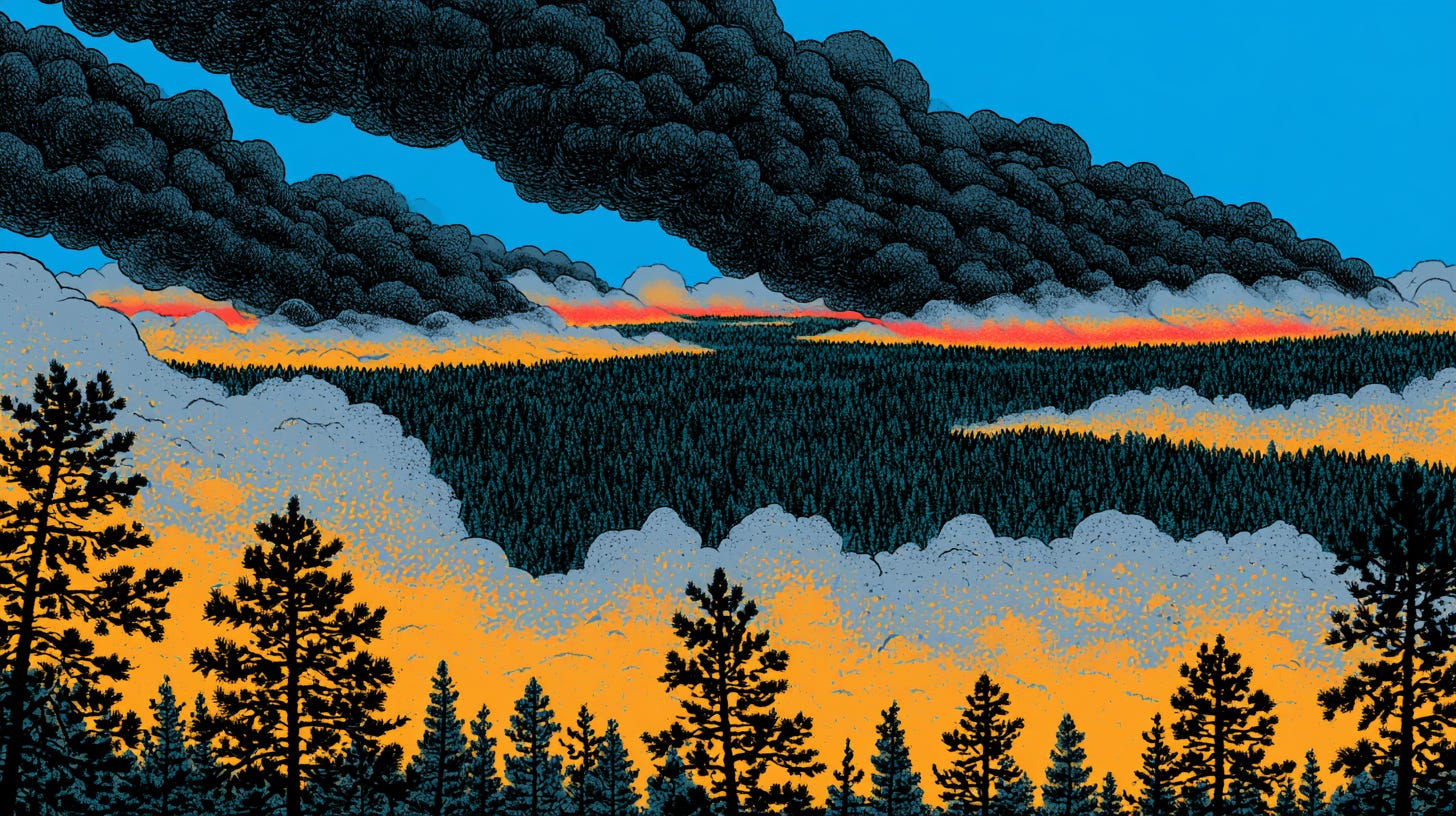
Across the Atlantic, Canada has about a quarter of the Earth’s boreal forest and, like Europe, is heating up at around twice the global average. It has experienced historically severe wildfire seasons over the last three years, with the worst on record occurring in 2023, when 15 million hectares (37 million acres) burned—an area larger than England. These generated 140 pyrocumulonimbi, whereas previous years had seen just one or two. Ontario and the Northwest Territories have been the worst affected this year, with 15,000 people evacuated in British Columbia. For a few days last month, Toronto had the world’s worst air quality, its citizens engulfed in fumes from fires raging hundreds of kilometers away. A 2024 study found that 1.5 million deaths per year globally are attributable to fire-sourced air pollution.
Canada’s political dispute over natural disasters, like that in Spain, is focused on the division between regional and national powers. Canada is the only G7 country that doesn’t have a centralized emergency unit to deal with wildfires, prompting Ontario premier Doug Ford to call for a “large national fire agency [because] [w]e seem to be going through this every summer.” The need for such an organization became even more urgent after two of Ontario’s indigenous First Nation communities—Namaygoosisagagun and Whitewater Lake—were destroyed by wildfires in July. Inhabitants of Namaygoosisagagun safely self-evacuated, despite having received no advance warning from the central government, while the ecosystems and infrastructure of Whitewater, a seasonal camping and fishing destination with no permanent residents, are thought to be ruined.
As you’d expect of a leader who believes that climate change is “the greatest con job ever perpetrated on the world,” Trump has fully exploited these fires’ potential for political point-scoring. As well as threatening Carney with financial retaliation for major US cities such as New York and Detroit “being unnecessarily invaded by filthy, polluted, and unhealthy air,” he blamed Canadian forest mismanagement for the scale of the blazes. Experts reject this diagnosis, pointing instead to the conditions created by climate change and the remoteness of Canadian forests, which make it difficult to reach fires in the crucial first 30 minutes. They have also highlighted the absurdity of Trump lecturing other countries on smoke pollution as he pursues his “energy dominance” agenda, under which he pulled the US out of the Paris Agreement earlier this year.
As Trump blames Canada for smoke pollution, the US is on course for one of its worst-ever wildfire seasons, with the amount of land burned so far about 50% over the ten-year average. The biggest blazes have occurred in Colorado, Nebraska, Utah, and Washington, while a fire in Calaveras County, California, has reignited tensions between Trump and the state’s Democratic governor, Gavin Newsom (referred to by Trump with the schoolboyish nickname of “Newscum”). When Trump visited Los Angeles for a GOP fundraiser in early August, Newsom urged him to fulfill his promise to “take care” of the survivors of last winter’s devastating Palisades fire. Since then, California has submitted more than $1.5 billion of reimbursement claims to the Federal Emergency Management Agency (FEMA, the kind of centralized unit Canada wants to create), of which only 2.5% have been processed. California’s attorney general Rob Bonta, meanwhile, is leading a group of 25 states that are suing Trump for attaching “unlawful” conditions to federal disaster aid through FEMA.
Announcing the EU’s new wildfire strategy earlier this year, Hadha Lahbib, the bloc’s Commissioner for Equality, Preparedness, and Crisis Management, said, “Wildfires know no borders, and neither should our response.” Collaboration, both between and within nations, will be key to effective wildfire management in the future—not only in fighting live blazes but in preventing their ignition. Perhaps a collaborative approach would also mitigate the political storms that accompany them.

Mark Nayler is a freelance journalist and critic based in Málaga, Spain. He writes regularly for The Spectator and Times Literary Supplement and is working on a biography of the philosopher Bryan Magee, due to be published by Bloomsbury (London) in 2028.
Macron is ineligible to run again.