

Bolivian Bind
By Fabricio Antezana and Nikolai Wenzel

As the second and final round of presidential elections in Bolivia approaches on October 19, the country seems to be closing yet another political cycle. After two decades of dominance, the socialist indigenism of Evo Morales’s Movimiento al Socialismo has finally been voted out.
The two leading candidates, Rodrigo Paz and Jorge “Tuto” Quiroga, don’t come from Morales’s party but rather represent a return to what many see as “old-style” politics. For the first time in decades, presidential hopefuls are openly discussing privatization, international investment, entrepreneurship, and even capitalism—words despised and avoided under Morales’s socialist regime. Yet not everything inspires optimism.
Quiroga, himself a former president (2001–2002), stirs fears of reviving the old political order in which “a few ruled over many,” while Paz, son of leftist ex-president Jaime Paz Zamora, faces criticism for his populist tendencies, past public charges, and his controversial vice presidential running mate, Edmand “Capitán” Lara, whose rhetoric often echoes that of Morales. Will these candidates continue promoting Bolivia’s never-ending statist cycle?
One of us writes from La Paz, Bolivia, where state intervention and socialism have been the norm for almost two decades, witnessing dwindling entrepreneurship and politicized institutions as the country crumbles to pieces. The other, an economist, has long studied the roots of prosperity and freedom across Latin America. We see the current situation in Bolivia not only as a political contest, but as part of a century-old cycle of interventionism and state dependence. We approach this moment as more than an election, as it may well be the latest chapter in a recurring pattern: when state power expands, freedom and prosperity recede.
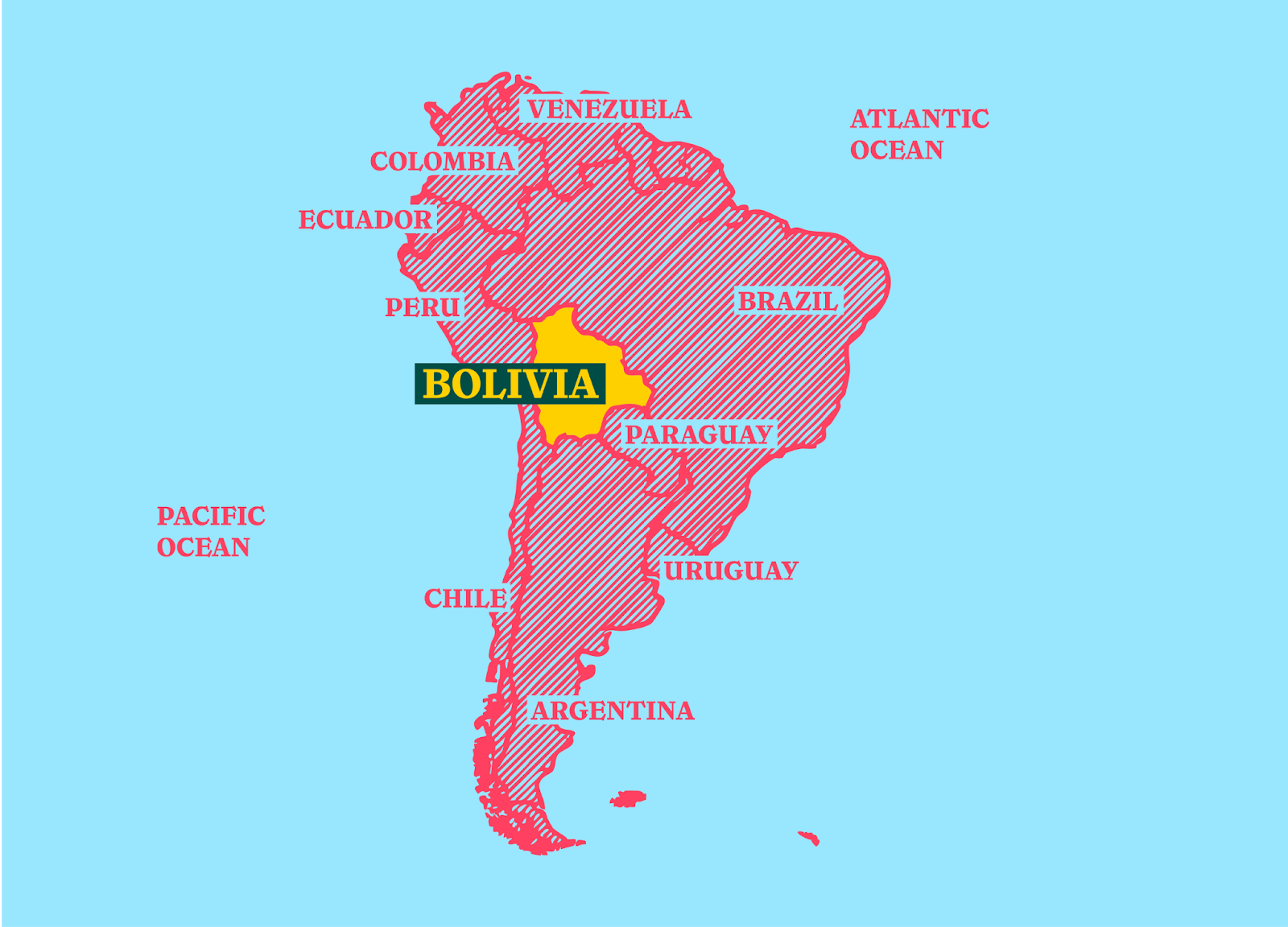
Bolivia is a landlocked nation in the heart of South America, bordered by Brazil, Peru, Chile, Argentina, and Paraguay. Home to about 12.4 million people, of whom 38.7% identify as indigenous, it remains one of the region’s smaller and poorer economies, with a GDP of roughly US $49.7 billion (about US $4,000 per capita). Its economy relies heavily on natural gas and mineral exports such as zinc, silver, and lithium, while agriculture and cattle ranching have expanded across the country’s eastern lowlands. Despite abundant natural resources, nearly one-third of Bolivians still live below the poverty line, and the state continues to dominate key sectors through subsidies and state-owned enterprises.
Bolivia’s chronic underdevelopment isn’t just about scarce resources or a weak entrepreneurial spirit. These are symptoms of a deeper disease: a persistently overreaching state. In each of Bolivia’s eras since independence in 1825, the state has morphed into a vehicle for redistribution, rent-seeking, and clientism, dynamics that have kept entrepreneurial energy away from productive wealth creation. Periodically, hope emerges for Bolivia, only to fade as state-driven institutional weaknesses send the country back, time after time, into crisis. Since the Fraser Institute began measuring economic freedom in 1970, Bolivia has consistently ranked in the third or fourth quintile of the least free countries in the world (with a brief respite from 1990 to 2005).
The Post-Independence Era (1825–1870)
After independence in 1825, Bolivia, once a jewel of the Spanish Empire thanks to its abundant silver, quickly fell into political chaos and economic stagnation. The new criollo elite had little experience with private landholding or self-government. Unlike the United States, where settlers held property and practiced decentralized governance, Spanish America ran on the encomienda system, with wealthy landowners controlling vast estates and the indigenous people living on them. Whereas lands in the future United States were given away by the British crown, all land in Bolivia belonged to the Spanish crown until independence. The wars of independence also wrecked the mining sector, the economy’s traditional engine.
The new state, dominated by caudillos (military strongmen), was weak and failed to build an integrated, entrepreneurial market. Instead, it leaned on the familiar colonial tool of direct extraction from the populace.
Instead of fostering an entrepreneurial class during the industrial revolution, the Bolivian state relied for income on the tributo indígena, a head tax on the indigenous peasant majority, which constituted about two-thirds of the population. With income guaranteed by taxation, the state had little reason to secure property rights, enforce contracts, or develop the legal groundwork for commerce and industry. Stagnation followed: from 1846 to 1900, GDP per capita grew just 0.7% per year on average.
The Silver and Tin Booms (1870–1930)
The late 19th century opened an era of civilian rule shaped by a new mining elite. The state stepped back from reliance on the tributo indigena, and adopted freer trade, thus plugging Bolivia into the global economy. For the first time, productive investment beat political maneuvering.
International capital, especially Chilean and British, flowed in. After an initial silver boom, entrepreneurship shifted to tin, which was suddenly in high demand from industrializing nations. By 1900, tin had overtaken silver as Bolivia’s main export, and the country emerged as a dominant producer. Growth surged and GDP per capita rose quickly in the first three decades of the 20th century.
But the boom rested on a narrow base. The economy depended on a single commodity and a few powerful producers, leaving it exposed to global volatility. Social strains also deepened. The Liberal Party’s reforms expanded markets but left many individual rights unprotected: only literate, property-owning males could vote, and labor remained quasi-feudal. Landlords could still extract free labor from those living on their lands (predominantly indigenous populations, who were treated as assets in land transactions).
In 1920, tensions between rival elites culminated in the first military coup, ending two decades of civilian, Liberal arty rule (classical-liberal).
The Rise of State Nationalism (1930–1977)
Bolivia slid back into a pattern of coups and military rule. The Great Depression and the Chaco War, a border dispute with Paraguay that lasted from 1932 to 1935, rattled the country. Statism returned. In 1938, the constitution was amended to give property a “social function,” thus opening the door to expropriation.
These tensions set the stage for the 1952 National Revolution. The new regime dismantled what was left of the 19th-century Liberal order, instituting state nationalism for the next three decades. The two main features were a nationalization of private mining interests into the COMIBOL mining monopoly (Bolivian Mining Cooperation), and a sweeping agrarian reform that expropriated estates and parceled land to indigenous communities under titles that couldn’t be sold, exchanged, or used as collateral.
The results were grim. COMIBOL predictably lacked the expertise and discipline of private management. It bled capital, used outdated equipment, and bowed to union pressures. In the countryside, once-productive estates, including those already industrializing, were broken into tiny, legally frozen plots. Output fell, and poverty rose.
To fund a swollen bureaucracy, COMIBOL’s deficits, and political demands for redistribution, the government printed money. Inflation blew past 100% in 1953 and 1956. Institutions now rewarded proximity to power over real production, and entrepreneurship shifted from mines and farms to rent-seeking.
The Collapse of the Statist Model (1977–1985)
Yet another coup in 1964 ousted the civilian government. The military kept the big-state model in place as it stayed in power. By the late 1970s, the flaws of Bolivian statism were compounded by a hostile world economy: recession, soaring interest rates that blew up foreign-debt servicing costs, and falling commodity prices. The system buckled, triggering a debt crisis that slid into one of the century’s worst hyperinflations.
From 1984 to 1985, the economy unraveled. With exports collapsing and credit cut off, the government fell back into its old habit of printing money to cover deficits. The money supply exploded; prices jumped an astonishing 20,000%, with monthly inflation near 60% in 1985, and prices doubling every few weeks. The peso boliviano became worthless, savings vanished, and trade shifted to dollars or barter. Hyperinflation marked the final failure of the post-1952 statist model, an economy run by political distribution and inflationary finance, instead of production and sound money.
A Brief Interlude (1985–2005)
Facing collapse, the civilian government elected in 1985 launched a “New Economic Policy” under the advice of American economist Jeffrey Sachs. Sachs is a PhD Harvard Economist who, after receiving a group of Bolivian officials at Harvard University, was invited to apply his knowledge to halt the crisis:
The least painful way to beat inflation, [Sachs] argued, was a clean break with the past, a regimen of fiscal and monetary discipline combined with an end to economic regulation that protected the elites and blocked the free market. “If you think you can do it,” challenged one official, “come to Bolivia and prove it.”
The economic reforms consisted of shock therapy that ended hyperinflation through market liberalization, austerity, a balanced budget, a floating exchange rate, and removal of price controls. Stabilization cleared the way for the 1990s reforms aimed at dismantling 30 years of nationalism.
The core was “capitalization.” Instead of cash sales, 50% of shares and full management of major state-owned enterprises went to strategic investors who injected capital equal to the firm’s value; the remaining shares went to new private pension funds for the elderly. The model drew about $1.7 billion, boosted productivity, and rapidly expanded the economy’s productive capacity. Natural gas reserves rose tenfold within five years, and the cities enjoyed broader access to electricity, phones, and water.
But growth takes time, and people are impatient. Even the most enthusiastic of market reforms cannot immediately fix 30 years of statism. The New Economic Policy was unpopular. Many saw it as a “fire sale,” aggravated by failures of key privatizations. The issue wasn’t markets, but weak institutions: poor rule of law, corruption, a politicized judiciary, biased regulators, and “crony capitalism.” Without secure property rights and reliable contracts, investment drifted toward rent-seeking. Market reforms don’t work in an institutional vacuum, and the perceived failure fueled a backlash that reopened the door to statism.
State Control on a Commodity Boom (2006–2014)
Disillusioned with traditional politics and the perceived failures of “neoliberal” reforms, voters elected Evo Morales in 2005. His MAS (Movement for Socialism) reversed market reforms and put the state fully back in charge. The 2006 energy reforms and nationalization gave the state majority stakes in the gas industry and a much bigger take through higher taxes and royalties.
Then the global super-cycle hit. Oil and gas prices soared, and natural gas revenue jumped from about $731 million to $4.95 billion in Morales’s first eight years. The cash financed big public works, new SOEs, and popular transfers. From 2006 to 2010, growth averaged 5.2%. By 2014, GDP per capita more than doubled. Poverty fell from 45%+ in 2006 to below 20% in 2019. In 2018, Bolivia’s economic growth ranked the highest in Latin America; Bolivia was even categorized as a “high human development” country in 2019 by the UNDP’s Human Development Index. This was seen as “a big win for socialism”; nationalization and state intervention seemed to work. But the model relied exclusively on high international commodity prices, not stronger fundamentals. The interested reader can find details here.
Bolivia’s Future
The economist William Baumol famously wrote about three kinds of entrepreneurship. Productive entrepreneurship creates wealth and innovation; unproductive entrepreneurship allows consumers and producers to survive barriers to market activity, but doesn’t create wealth; and destructive entrepreneurship erodes the economy through redistribution and state favors. The kind of entrepreneurship that emerges depends on the incentives created by the state.
Bolivia doesn’t lack resources or talent. With silver, tin, natural gas, and major lithium reserves, and a strong entrepreneurial spirit, it could be an economic powerhouse. The obstacle has been a state that keeps taking center stage and creates perverse incentives for entrepreneurs. In the rare moments the state steps back, Bolivia grows.
If the country keeps chasing “change” without loosening the state’s grip, it will stay grounded. The way out is to rewrite the rules so that they reward productive entrepreneurship: starting businesses, innovating, and competing in open markets. Until leaders and citizens choose that institutional shift, Bolivia will remain stuck at the same crossroads, waiting on a recovery that never lasts.

Nikolai G. Wenzel is a Research Fellow of the American Institute for Economic Research and a member of the FEE Faculty Network. He is Professor of Economics and Director of the PhD and MA in Economics at Universidad de las Hespérides (Spain) and a member of the Mont Pelerin Society.
Fabricio Antezana Duran is Social Media Associate at the Foundation for Economic Education. He is pursuing a BA in Business Administration at Universidad Privada Boliviana in La Paz, Bolivia.
“Bolivia doesn’t lack resources nor talent” is by far the most sad yet true statement!
🇧🇴🇧🇴🇧🇴