

Atlanta’s Invisible Hand
A Native Son Reflects on the City, on the 30th Anniversary of the Olympics

There’s a particular quality to the light in Atlanta in late spring. It comes through the water oaks by the Chattahoochee River at a low, golden angle, the kind of glow that turns even ordinary things—a parking deck, a gas station marquee, a man in a Falcons hat walking his dog—into something worth remembering.
The light feels native to me, acquired before memory had the decency to begin. Piedmont Hospital, 1983. I was held up to a window that first afternoon, a small, blinking witness, and I like to imagine that the nurse holding me recognized the setting sun and knew it was worth the trouble to let me see.
I grew up in Marietta, which is to say I grew up adjacent to Atlanta, breathing its air, eating its food, absorbing its noise and ambition and heat as a sponge absorbs water.
I eventually left for college and returned in 2010 because Atlanta has a way of calling you home. I left again in December 2012 for Auburn, Alabama, a fine spot in its own right, where I remain.
But between the years of my birth and my departure, I watched this city grow as one watches a child develop: not day by day, where the changes seem invisible, but in sudden lurches that make you step back and say: When did that happen?
At one level, it was commerce. At a deeper level, it was something else: a story.
In the late 1980s, when I was still small enough to be carried on shoulders at Braves games, Atlanta was beginning to understand what it was becoming. The skyline was filling in. John Portman’s great gleaming towers—the Westin Peachtree Plaza, the Marriott Marquis with its vertiginous atrium that made you feel you were standing inside a dream—were already there, already asserting that this was not a Southern backwater, but something else entirely.
More than a thousand foreign companies from 35 different countries had chosen to plant their flags in the metro area by the middle of the decade that followed. Coca-Cola, CNN, and UPS were not merely Atlanta companies, but global players. Delta Air Lines was making Hartsfield into something staggering, and by the end of the 1990s, it would become the busiest airport on Earth, a portal through which the entire planet passed.
Then came the 1996 Olympics, an episode outsiders prefer to remember as a bright, self-contained instant, as if it arrived, dazzled, and departed.
It did not. It altered the place. We’re at the 30-year anniversary of that hinge point.
Money—more than 2 billion dollars of it—poured in, much of it extracted rather than earned, redirected by planners rather than chosen by individuals, and with it the visible rearrangement of streets and habits that always accompanies political allocation.
A worn industrial tract of 21 acres downtown was stripped to its bones and remade as Centennial Olympic Park, which became, and remains, the pulse of that district. Hotels rose, glass catching the Georgia light like new promises. Most of my memories of that place from that time are quite pleasant. The park itself was the pulse of the whole affair: concerts spilling out over the grass, food carts sweating under the Georgia heat, children sprinting in wet circles through the Fountain of Rings like it had been installed for no other purpose than their temporary joy.
And then, as if someone had reached into the middle of a well-edited film and swapped in a different reel, a pipe bomb went off. Over 100 people were injured, one was killed, and the whole scene tilted into something unrecognizable. The FBI, in its infinite confidence, briefly decided that the villain must be Richard Jewell, a man whose sins, as far as anyone could tell, were limited to being in the wrong place, at the wrong time, and possessing the unfortunate physique of someone America is always ready to distrust. The actual author of the chaos, Eric Robert Rudolph, remained elsewhere for a time, presumably pleased with the confusion he had sown.
If one is inclined toward arithmetic, there is a small, persistent question hovering at the edge of the spectacle behind that Olympics: Who paid, and who decided? Politically allocated money has a way of presenting itself as destiny, masking the reality that it is merely redirected from other, unseen uses.
Grand events have a habit of counting their triumphs in ribbon-cuttings while leaving the ledger of costs—displaced lives, redirected resources, opportunities forgone—to quieter rooms. What endured was not the spending, but the underlying market process that would have proceeded—more efficiently and more humanely—without it.
Office towers rose. People who had given up on downtown living came back. Atlanta’s economy, always more diverse than the old cotton-and-tobacco South, proved resilient beyond what quieter cities ever imagined: even as the rest of the country shuddered through the recession of 2002 and 2003, metropolitan Atlanta was adding jobs, its labor force expanding while others contracted.
There’s a lesson in that, and I will come to it. My father was in the insurance business in Atlanta and loved the capital of the New South. When the company where he served as president of the Atlanta office was acquired by a larger firm, he had options—as men of his ability tend to have—but he stayed, because he wanted to raise his family here.
Now, among his colleagues at that firm was a man named Bob Wilson. He was a character, in the precise Southern sense of the word—that is, he lived just beyond the ordinary social contract, often to great comic effect, and left everyone around him both grateful he existed and a little uneasy about what he might do next.
Bob Wilson had a sailboat. This is relevant, I promise.
He kept it on Lake Lanier, which, for those of you who don’t know it, is a large reservoir north of Atlanta created in the 1950s by the flooding of a valley and the forced displacement of several small towns, which gives it a slightly Gothic backstory. My father, my brother, and I joined Bob a few times for overnight sailing trips on that lake, anchoring near one of its many small islands as the Georgia dusk came down over the water and the trees went dark.
On one of these evenings, anchored in that particular stillness that only exists on lakes after sunset, Bob Wilson did what Bob Wilson apparently could not help doing: he cupped his hands around his mouth and shouted toward the dark tree line, “Who’s there?” And then he answered himself, in a deeper, more theatrical voice, warning us that there were pirates about.
Pirates. On Lake Lanier. In Forsyth County, Georgia.
Now, this requires a brief digression, because the word pirate has picked up, over the centuries, a romantic varnish it scarcely earns but which we all continue, half-knowingly, to preserve. One might say that the original pirates—the Blackbeards and the Bartholomew Robertses—represent the free market pushed past its institutional guardrails, but this is a category error. Piracy is not the free market carried too far, but the destruction of markets altogether: the violation of property, the negation of consent, the substitution of force for exchange. There’s nothing entrepreneurial about plunder except the superficial resemblance to risk.
The truth does not lie between theory and gallows. Where property is not respected and exchange is not voluntary, what exists is not a market in failure, but no market at all. Predation is not an extension of liberty; it is its destruction.
Bob Wilson’s pirates, I am relieved to report, belonged to neither camp. They were not market actors at all, nor were they predators in any meaningful sense. They were inventions: purely theatrical, conjured out of shadow and suggestion. And when my younger self scanned those trees with apprehension, there was nothing there but pine and Georgia night. The market, in that instance, produced no pirates whatsoever.
But another group of Pirates did come to Atlanta, in events that would be etched on my mind. October 14, 1992, is one of those moments for everyone who was in Atlanta, loved Atlanta, or had any warm feeling whatsoever toward the Atlanta Braves.
Game 7 of the National League Championship Series: the Braves against the Pittsburgh Pirates. Fate, it seemed, had decided to indulge a certain lightness of nomenclature that season.
The Pirates carried a 2-to-0 lead into the bottom of the ninth inning. Their ace, Doug Drabek, had been magnificent for eight innings. Three outs were all Pittsburgh needed—three outs, and a trip to the World Series. And then—because baseball is not a sport so much as a form of extended theological argument—the bottom fell out.
Terry Pendleton doubled. David Justice reached on an error. Bream walked, loading the bases. Stan Belinda came in from the bullpen. Ron Gant hit a sacrifice fly. Then a walk to Damon Berryhill. The tying and winning runs sat on base. Two outs. The next hitter was Francisco Cabrera, a man who had batted exactly 10 times during the entire regular season, a man who existed at the very outer margin of the roster.
And who singled into left field.
Barry Bonds fielded the ball in left.
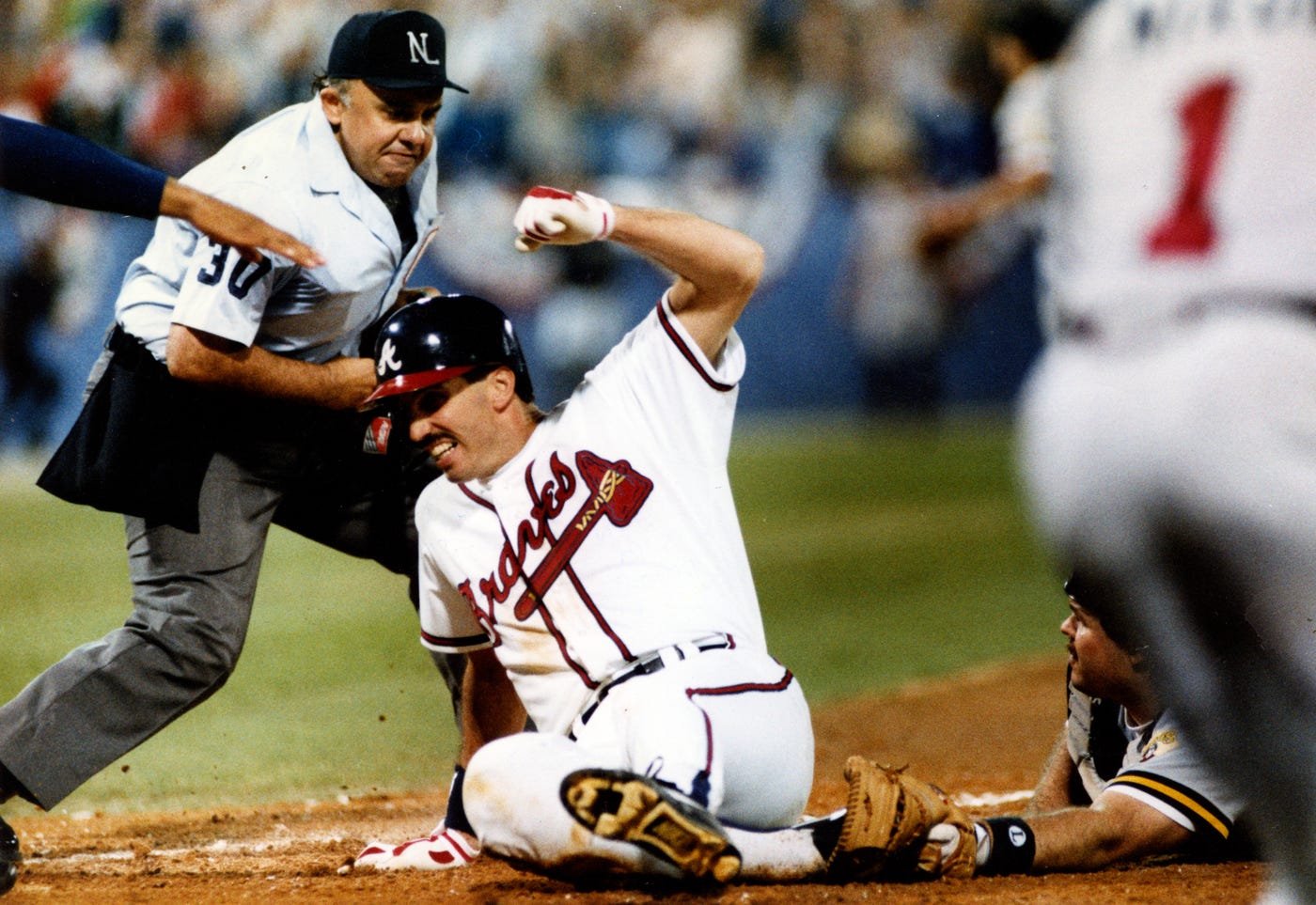
Sid Bream—yes, Sid Bream, who had played six years in Pittsburgh, and had come to the Braves from Pittsburgh when the Pirates decided that his surgically reconstructed knees weren’t worth the market price—that Sid Bream came around third base.
He slid. The throw from Bonds came in slightly off-line. The catcher swiped. The foot got there first.
Safe.
I was nine years old. I remember the sound of it, even through a television set in Marietta: the hysteria of 60,000 people simultaneously losing their minds in the best possible way. I can close my eyes right now and hear it.
The Pirates, after that night, fell apart. Barry Bonds left via free agency. Doug Drabek left. The team that had won three consecutive division titles began the long dissolution that free agency and economics demand of rosters that can’t afford to keep what they have built.
The Pittsburgh franchise entered a two-decade decline as its best players departed for richer markets. There is, if you are inclined toward that kind of observation, something instructive in this about the free movement of talent and capital. Sid Bream himself had been, in a sense, a free-market outcome: the Pirates hadn’t valued him at his market price, so he had gone where the price was met. He went to Atlanta and broke Pittsburgh’s heart with the very legs they had declined to pay for.
Prices are information; they tell you what things are worth, and when you suppress or ignore them, you get consequences you did not intend. The Pirates didn’t believe Sid Bream’s knees were worth keeping. The consequence came sliding across home plate in the bottom of the ninth.
What made this hub great—what made it grow from a metro population of 2 million in 1980 to more than 5 million by the time I was leaving for Auburn—was not any single act of government planning, though political actors did plenty of tinkering, often mistaking motion for progress. It was the accumulated consequence of millions of individual decisions, made by businesses large and small, by entrepreneurs and workers and immigrants and investors, all responding to prices and opportunities and the simple animal desire to be where something is happening.
Hartsfield-Jackson became the busiest airport in the world not because a committee decided it should be, but because Delta and the other carriers kept responding to demand, and demand kept responding to the city’s position as the great center of the American South. CNN was founded here because Ted Turner looked at the media landscape, saw an inefficiency, and filled it with continuous news. Atlanta was low-cost, and a non-union city. (That Turner grew up in Georgia and had other businesses nearby probably helped.)
Coca-Cola had been here since 1892, predating almost every other local business, and it stayed because Atlanta offered what any business ultimately requires: a place where those with ability choose to live, where transportation is available, where property rights and the rule of voluntary exchange are predictable enough to make long-term investment sensible.
The 1996 Olympics, despite their subsidies and spending, did not create Atlanta’s economy; rather, they revealed it. When you host the world, the world looks at you, and what the world saw in Atlanta in 1996 was a city that had been doing the unglamorous, unheralded work of building itself for decades. The convention business, the hospitality industry, the logistics network—none of it materialized in 1996. It had been accumulating, compounding quietly, as a good investment does, since long before I was born in Piedmont Hospital in a year when the Braves were still struggling, and Coca-Cola was changing its formula in what remains one of the great self-inflicted economic wounds in corporate history, a story for another evening.
The free market is not a machine. It’s a spontaneous order—more like an ecosystem than a machine—emerging when voluntary exchange, honest prices, and secure property are left alone.
Nobody planned TLC. Nobody planned Outkast or the rise of Atlanta hip-hop as the dominant cultural force in American music. These things happened because the conditions for them existed: a city large enough to support diverse cultures, accessible enough to attract talent, as well as support home-grown genius. A city unconstrained enough for talent and culture to find their own forms without interference. And the world’s busiest airport to get them there.
I will tell you what I believe, standing here in the metropolis where I was born, and it is this: a place and a person grow the same way. Not according to plan. Not according to the instructions of some authority that has decided in advance what the outcome should be.
They grow through voluntary choices, trial and error, profit and loss; through the discipline of reality rather than the preferences of authorities; through opportunities and its catastrophes, its Bob Wilsons and its volcanic emergencies; and by responding with whatever combination of wit and stubbornness and good humor the situation demands.
My father stayed in Atlanta when he could have gone somewhere easier. The city stayed itself when it could have become something smaller. Both of them, the man and the city, grew by being willing to be tested, to push on.
The Braves, that glorious and maddening franchise that I have followed from infancy, won one World Series in the 1990s—1995, over Cleveland—and reached the Fall Classic five times in that decade. Five times. They were, by almost any measure, the dominant team of the era, and they came away with only one championship, which is the kind of ratio that will either destroy a fan’s soul or teach him something important about the difference between excellence and satisfaction, between the journey and the destination.
I have spent forty-odd years negotiating that lesson. I am still not entirely sure I have learned it.
But I remember October 14, 1992. I remember Sid Bream’s foot on home plate and the sound that came up from Fulton County Stadium and traveled north to Marietta, where a nine-year-old boy was watching with the complete, uncomplicated faith that something wonderful was happening.
That memory belongs equally to me and to this city. It’s the kind of thing that gets into the blood and stays there, not as nostalgia exactly, but as evidence—evidence that extraordinary things happen in ordinary places, that the improbable is always a ground-rule double and a sacrifice fly and a wild pitch away from becoming the actual, and that the greatest slide in Atlanta history was made by a man on surgically reconstructed knees who had been told, once, that he was worth less than he was.
He proved them wrong on borrowed legs.
That, I think, is the Atlanta story. That is the market story. That is what happens when people are left free to act, to exchange, to fail, and to try again—and it is the only story that has ever reliably produced prosperity. I’m glad to have been born here.

Allen Mendenhall is a Senior Advisor for the Free Enterprise Initiative and a Research Fellow in the Thomas A. Roe Institute for Economic Policy Studies at the Heritage Foundation. A lawyer with a Ph.D. in English from Auburn University, he has taught at multiple colleges and universities across Alabama and is the author or editor of nine books. Learn more at AllenMendenhall.com.
Great piece. As a Cobb County libertarian, I am torn between my faith in the free market to provide affordable housing, and my concern that too many apartment complexes in the County will turn Cobb into as blue a place as Fulton and Dekalb. Does the author have a suggested solution to my quagmire?
I'm from Northeast Ga (80 miles NE of Atlanta is how I describe it). Love this article. Every Christmas for years my whole family (5 girls, 2 parents) would drive those 80 miles to go to Rich's to see Santa and ride the Pink Pig Flyer! And eat in the Magnolia Room! Great memories. I'm living in Virginia now, so thanks for the reminder of this great city.