

Artist vs. Audience
When Reacting Beats Reading


There’s a scene in My Year of Rest and Relaxation, the novel by Otessa Moshfegh, where the protagonist takes a dump on a piece of modern art. That’s not a euphemism: she literally does this, defecating in the middle of an installation at the avant-garde gallery where she works.
This moment represents a turning point for the nameless heroine, a final conscious act of rebellion before she embarks on a project to spend the entire next year sleeping—and sleepwalking—in a dissociative state brought on by an increasingly potent cocktail of mood-altering drugs. It is also extremely funny. But—and this is crucial—the protagonist doesn’t see it as such, for the same reasons American Psycho’s Patrick Bateman wouldn’t understand why you keep giggling when he’s monologuing about Huey Lewis in between committing murders. Like any good satire, Moshfegh’s novel stays cool and earnest within its own narrative framework, always holding back from the sort of self-indulgent absurdity that would tip it over into farce.
As such—and also like any good satire—the book attracted a number of readers who took it so literally, and so seriously, that they not only completely missed the joke but would have been horrified to learn that Moshfegh was making one. Some of them believed it was transcendent, a brave and stunning work of liberation for broken women everywhere which (as one representative review put it) could “transform the novel into a space where that woman is able to bleed and break apart, where she has permission to lose herself and not be wrong.” Others, including a professional critic for the Los Angeles Review of Books, treated the book’s insouciance like a moral flaw rather than intentional feature. “Most people in the United States can’t afford to live alone as the narrator does, and many more can’t afford the necessities of life, even while employed and working,” she wrote, citing statistics from the United Way before arguing that the story “makes light of people who truly experience life-changing conditions that make self care difficult or impossible.”
You’ve probably heard by now that America is in the grips of a literacy crisis, thanks to our broken education system or smartphone-addled attention spans or some combination of the two. But there’s another facet to this, one that isn’t killing literacy so much as hollowing it from the inside: a crisis of understanding, one fueled by an inability to tolerate the discomfort of intellectual exercise, which is in turn fueled by an endemic resistance to friction of any kind.
There are various reasons why this is happening now. There’s the rise of the attention economy—and with it, a growing consensus that being asked to expend any of said attention on comprehension is a sure sign that you’re being scammed. There are our endless, internecine culture wars, whose participants can no longer discern the difference between a noncombatant and an enemy. There’s the Internet itself, a space with boundless surface area but little depth, where writers are forced to act as creators, curators, brand managers, and actuaries for a product whose audience could be literally anyone. But the impact is singular: a fundamental transformation of how we engage with the written word, with particularly serious implications for those who write those words.
As the author of six books, hundreds of essays, and a truly unconscionable number of tweets, I find this phenomenon equal parts alarming and fascinating in all its iterations. The oddly humorless reviews of My Year of Rest and Relaxation are a microcosm for a discourse in which sophisticated critique is out and morally prescriptive literalism rules the day. Outraged literary critics, unable to comprehend that depiction is not the same as endorsement, insist that the views of a fictional villain must necessarily represent the beliefs of the author who created him; professional journalists, having traded objectivity for moral clarity, struggle to parse the difference between explaining a thing and excusing that thing. This is to say nothing of social media, where intolerance for ambiguity is something approaching an art form. It’s not just irony that readers struggle with, but allegory, parody, hyperbole, vocabulary; an increasing number seem not to understand the difference between a metaphor, a microcosm, and an analogy, and that’s if they even bothered to read the article before commenting, which many do not, because they don’t think they should have to.
I read the part in the screenshot.
I skimmed it.
I don’t need to read it to know what’s in it lol lol lmao.
None of this is shocking if you understand the animating principle behind it: a sincerely held belief that it is the writer’s job to make himself understood by readers, even when those readers don’t so much read a text as skate over the face of it like a waterbug. The notion that true understanding might require getting their feet wet is one they neither believe in nor appreciate.
There are two types of literary misunderstandings. The first is an authorial failure to communicate. Perhaps your assertions were overbroad, or your word choices sloppy; you were technical where you should have been lyrical or provocative where you should have been conciliatory. Perhaps you failed to assert your thesis clearly enough, early enough, creating understandable confusion. Perhaps you posted a joke on Twitter that you should have saved for the group chat, a category error with which I definitely have no personal experience whatsoever. The point is, you meant one thing, but you wrote another thing, and of course the fault lies with you.
But the second type of misunderstanding, and this is much more common, is that you meant one thing, and you wrote that thing—but your work has now reached a reader who wasn’t interested in that thing. He’s interested in a different thing. He wanted you to write a different thing. A different thing is what he would have written; a different thing is what he wants to talk about.
Most importantly, the fact that you wrote that thing and not a different thing makes him very uncomfortable.
More common, and more frustrating, because whose fault is this? Nobody’s, really. It isn’t even a misunderstanding so much as a fundamental hazard of creating written work in a place where anyone can see and comment on it—and particularly of writing that refuses to dumb itself down to a lower common denominator of legibility in order to indulge in subtext, or irony, or complexity, or ambivalence. Every expressed idea, even one as brief as a tweet, has an intended audience of people who will get it. But in order to find that audience, the idea must necessarily pass in front of a second, much larger group of people for whom it was not intended. People who don’t get it. People who don’t like it. People who are outraged, actually, that they had to encounter this idea at all, and who resent the hell out of whoever left it in the middle of the discourse for them to trip over.
In March 2024, the literary magazine Guernica published “From the Edges of a Broken World,” a portrait of Israeli life in the wake of the October 7 attacks by writer and translator Joanna Chen. It was a beautiful essay: lyrical, searing, and frank in its depictions of the author’s horror at the violence inflicted both on Israel by Hamas and by Israel on Gaza. It couldn’t have been easy to write; it was not easy to read. And while the piece found its intended audience, it also found a much larger, much louder audience of people for whom it was not intended: people who not only didn’t want to read it, but wanted it not to exist.
In her essay, Chen recounted a conversation with a friend, a woman whose children are terrified by the sound of bombs dropping across the border in Gaza. “I tell them these are good booms,” the friend says. It was those two words, “good booms,” that people seized on, with an anti-intellectual fervor that would have been funny if not for its profoundly disturbing implications about the state of conformism in the literary world. According to Chen’s critics—all of whom were highly literate people, many of whom either wrote books or wrote about them for a living—“good booms” could only be interpreted as a representation of the author’s own feelings about Israel’s bombing of Gaza. She thought the booms were good, because she thought the bombs were good, because she wanted Palestinian children to die.
If asked, these people would have unanimously proclaimed that this was Chen’s fault, a failure of the writer to make herself understood.
Of course, they would have been lying. These people were not trying to understand Chen’s essay; they were trying to censor it. And they did. Amid the backlash, Guernica scrubbed the essay from its website and apologized for having published it. (It was later republished by the Washington Monthly.)
At the time, I described this entire incident as “a depressing reminder that even the most literate among us are not above pretending, for the sake of tribal signaling, to have the intellectual capacity of a turnip”—and true enough, it was. But what I find more worrisome is how ubiquitous this behavior has become over the past decade or so, how much the discourse has been transformed by it. Chen’s bad-faith critics were uniquely successful in weaponizing their mischaracterization of her work, but the mischaracterization itself was par for the course in a world where people are often less interested in understanding whatever they’re reading than they are in reacting to it. Everyone has a platform; everyone has an opinion; and everyone knows that they’ll get more engagement by grandstanding in a quote-tweet than by having a conversation.
The attention economy incentivizes this behavior so strongly that it is increasingly rare, even among fellow writers, to find someone who wants to talk through an intellectual disagreement rather than sensationalize it for their own audience. Case in point: a few weeks ago, I wrote a short blog post about the impulse to flatten real people and events—including both the tragic killing of Alex Pretti in Minneapolis and Alex Honnold’s summiting of Taipei 101—into tidy narrative boxes that stripped them of both truth and humanity.
The next day, a fairly famous journalist, a woman who I’ve been friendly with for years and have spent time with in person, posted an out-of-context quote from the piece and accused me, bizarrely and falsely, of smearing the protesters in general and the deceased Pretti in particular as “cosplayers.”
I was baffled enough to message her privately: if she didn’t mind, I asked, perhaps she could just send me a DM next time? Not that it mattered by then: her description of my work was the equivalent of someone installing a giant neon sign that read LIVE NUDE GIRLS with a flashing arrow on the roof of a specialty pet store. The sign is all anyone sees, and all anyone cares about; more importantly, to the group of outraged puritans who gather outside the store in protest, the fact that the sign says something outrageous is far more interesting than whether it says something true.
It doesn’t even matter, then, that the closest thing to a live nude girl inside the store is a lone, hairless cat, asleep in one of the display cases. The people screaming on the sidewalk haven’t even looked inside—or if they did, they caught a glimpse of the hairless cat and immediately ran back out to inform the rest of the crowd that they’d seen enough to know there was definitely something nude and alive in there, and we should all be outraged.
To bring this tortured metaphor to its merciful end, the problem with this is not just that the store owner’s business suffers, or that his life is made unpleasant. It’s that the small group of people who compose the store’s intended audience—the ones who showed up not to protest, but to buy a bedazzled tiara for Fifi—are chased away by the ones screaming on the sidewalk.
Similarly, the readers for whom my essay was intended were soon drowned out by a larger, louder group who piled into the comments, screaming at me to delete the disgusting bootlicking defense of fascist murder they’d been reliably informed I wrote.
Perhaps your impulse, in moments like this, is to correct the misunderstanding. Mine certainly was, which I thought would be easy—the essay was right there!—but more than that, like a fool, I thought people would be pleased to realize they’d been mistaken. Wasn’t it a relief, to know that there was one less work of fascism apologia in the world than they’d previously feared?
But however angry my critics were, nothing made them angrier than being told they’d misunderstood; indeed, they refused to believe it. I was lying. I was obfuscating. I was merely pantomiming nuance, compassion, and consideration in order to hoodwink people into letting their guard down—presumably so that I could, at some future point, emerge from the belly of my innocuous-looking essay and put MAGA hats on everyone while they slept.
If this was a misunderstanding, the problem was not the prose.
There’s a meme—you’ve probably seen it—of a text conversation between two people. The original features a lengthy message on one side of the screen; on the other, a terse reply:
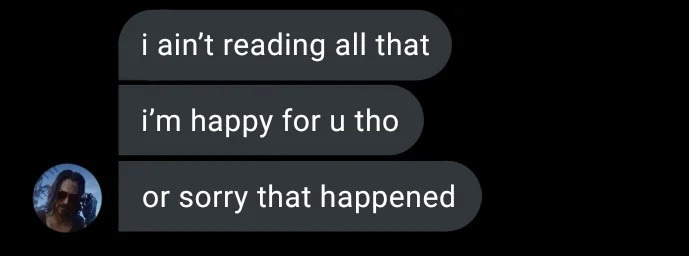
Whatever function this meme served in its original iteration, today it does a remarkable job of capturing why we find ourselves in a collective crisis of understanding. Literacy is part of it, to be sure, as is the loss of intellectual stamina fueled by the endless scroll. But it’s also about fear, mistrust, exhaustion, and a totalizing obsession with politics as a proxy for character. It’s about a world where attention is a commodity, and friction is intolerable, and where the greatest moral virtue of all is to be both suspicious and belligerently incurious about any idea with too many moving parts.
It is about the conviction that good faith and productive discussion are for suckers, and that anyone who asks you for this is trying to make one out of you.
It is also, of course, about media and the people who work in it—and who are struggling to keep a toehold in a professional landscape that was precarious and cutthroat even before the extinction-level threat of LLMs appeared on the horizon. It’s worth noting that many if not most viral literary controversies, the ones that end up at the top of your newsfeed because so many high-profile, high-follower accounts are weighing in, are nominally about the writing but actually about the person who wrote it, or the outlet they wrote it for, or the person who founded the outlet they wrote it for and no I’m not thinking of anyone in particular, why do you ask.
There’s a lot of professional jealousy, a lot of petty beefing—and while the contours of these individual conflicts are mostly silly and don’t matter, the emotional state of their participants does, insofar as these are the people who shape the national discourse. The peak of cancel culture may have passed, but not so much its impact on the elite spaces where culture is created, where conformist sentiment remains significant. To write professionally in the year 2026 is to be besieged by competing pressures: to placate professional rivals and online tastemakers, who may not be able to destroy your reputation but can certainly make your life unpleasant if they put their mind to it; to sidestep the traps of audience capture, virtue signaling, and your own reflexive biases; to anticipate the complaints of bad-faith critics without pandering to them.
I see my fellow writers seeing all this, and getting nervous. I don’t blame them; I’m nervous myself. They are doing their best to tiptoe through this minefield: writing from a defensive crouch, checking their privilege, signaling their politics as plainly as possible in order to preempt accusations of being on the wrong side. They show their colors—I’m one of you! I’m one of the good ones!—and hope the audience will believe them enough to read charitably; they strip the complexity from their work to avoid being misunderstood or misconstrued.
I don’t blame them.
But I wish they wouldn’t.
There is, of course, an audience for this type of writing. The modal reader in the current year is often as not a person who doesn’t read literature so much as consume content—who doesn’t see any difference between these two things—and who is nominally interested in knowing what other people think but only as long as he doesn’t have to think too hard about it himself. For this person to discover that an author has expectations of him, that the ideas in play are not only textured, but tough, and need to be chewed on for a while if he wants to extract the full flavor of what is being expressed? No doubt this seems wildly unreasonable, a cruel provocation—which is perhaps why so many people react to being told they’ve misunderstood a piece of writing, that they need to read more closely or carefully, as though they’ve been slapped in the face.
Perhaps this is understandable. Nobody likes to make mistakes, and being told they’ve misunderstood no doubt feels, to some, uncomfortably close to being called stupid. But what I wish people understood better—and the hill I will die on, if necessary—is that every complex work of literature, from esoteric poetry to ironic satire to twisty investigative reporting to galaxy-brained cultural criticism, is an expression of faith in the intelligence of the reader. When a writer indulges in nuance, or ambiguity, or irony, it’s not because he’s trying to put one over on you; it’s because he’s trying to express the truth as he understands it to an audience that shares his desire to understand the world. But there’s no way to reach that audience, to have his work read by the people who will get it, without accepting the risk of being misinterpreted by the people who don’t.
It is, of course, up to the writer to decide just how much misunderstanding he can tolerate. But surely some is worth it, not just for the sake of creating more interesting and layered work, but for giving readers the opportunity to rise to the occasion of a more challenging text. Some, of course, will not take it; they ain’t reading all that. Some, like the reviewers who mistook My Year of Rest and Relaxation for either a beautiful, unflinching portrait of depression or a repulsive paean to privileged white womanhood, will try and fail and never know what they’re missing.
Some of them will know they’re missing something, and resent you for it.
But some of them—the ones you wrote the work for in the first place—will not balk at being asked to come and think with you. They’ll read before reacting, perhaps even more than once. They’ll recognize when you’re joking, even if they don’t laugh; they’ll understand what you’re getting at, even if they don’t agree. And good, because what a dull world it would be for writers if every story, every essay, every idea, was only ever met with bland assent; what a waste it would be to dedicate our lives to the work of saying something, only to find that nobody else thinks it’s worth talking about.
But this is why, even when it feels fraught—and even when it means being misunderstood, intentionally or otherwise, by an audience you never wanted—it is worth it to write authentically. To say what you mean to say, even if it’s not what someone wants to hear. Because a writer’s purpose, and privilege, is to seek truth, to understand the world, to find meaning in the messy business of being human—and if we’re very lucky, to find ourselves in conversation with readers who want the same.
Kat Rosenfield’s How to Survive in the Woods releases March 10.
Kat Rosenfield is a culture writer and columnist at The Free Press, and the Edgar-nominated author of six novels.
Excellent work. The *willful illiteracy*
is exhausting.
I completely understand that writing for a public audience means you will receive a certain amount of backlash. And people will critique. But the volume of bad faith arguments and people superimposing, their own personal preferences onto something that you literally did not say is bad for all involved.
In some ways, the old days when you had to actually write a letter to the editor or perhaps write an email to the Writer things were better.
Just remember: If your writing isn't pissing somebody off, you are doing something wrong.